
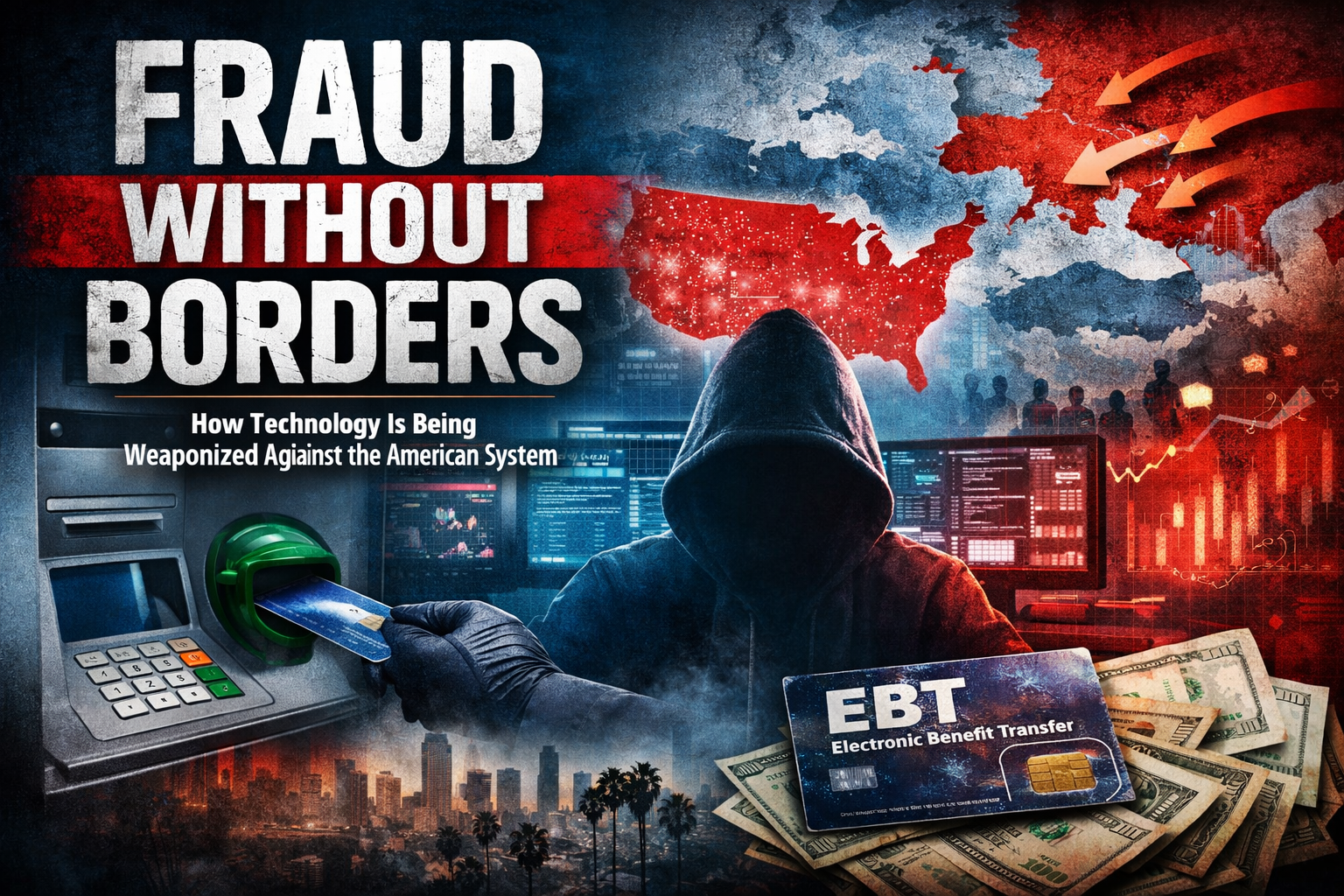
Fraud is having a moment in the headlines, but not the kind driven by petty grifters or isolated bad actors. What law enforcement, financial institutions, and social service agencies are seeing today is something far more industrial, organized, technology enabled fraud carried out at scale, often from thousands of miles away.
This is not a moral panic and it is not about immigration. It is about foreign based criminal enterprises that have learned how to exploit American systems faster than those systems can adapt. And nowhere is that more visible than in payment fraud, skimming operations, and EBT fraud across large urban counties like Los Angeles.
The New Fraud Model: Remote, Modular, and Relentless
Traditional fraud once required proximity. You needed to be physically present to steal a card, forge a check, or impersonate a victim. That model is largely obsolete.
Modern fraud is modular:
- One crew installs skimmers or shimmers on ATMs and point of sale terminals.
- Another group harvests and validates stolen data.
- A third cell encodes cards, launders funds, or monetizes accounts.
- A foreign based command structure coordinates operations, replaces burned assets, and moves profits offshore.
Technology is the glue. Encrypted messaging apps, anonymized email accounts, VPNs, and cryptocurrency allow these groups to operate like distributed startups. When one node gets shut down, the rest keep running.
Skimmers Have Grown Up
Skimming is no longer a crude overlay taped to an ATM. Today’s devices are:
- Ultra thin shimmers inserted directly into card slots
- Bluetooth enabled for rapid data exfiltration
- Paired with pinhole cameras or compromised PIN pads
- Installed and removed in minutes
In Los Angeles County, investigators routinely see skimming crews that are not improvising. They arrive with rehearsed roles, pre tested hardware, and precise timelines. The technical sophistication is rarely homegrown. Designs, firmware, and operational playbooks originate overseas and are refined through trial, error, and shared criminal knowledge.
The street level installer is disposable. The infrastructure is not.
EBT Fraud: A Perfect Storm of Trust and Technology
Electronic Benefit Transfer systems were designed to be efficient and dignified. They were not designed to withstand hostile, nation scale fraud ecosystems.
EBT fraud has exploded because it sits at the intersection of:
- High transaction volume
- Predictable usage patterns
- Limited real time fraud controls
- Vulnerable retail endpoints
Foreign based actors exploit this by pairing skimming operations with rapid monetization. Benefits are drained almost immediately after deposit, often before the cardholder even knows what happened. Victims are left without food, agencies are overwhelmed, and public trust erodes.
From an investigative standpoint, the money often leaves the country faster than subpoenas can be drafted.
Why Foreign Networks Thrive
A Note on Transnational Organized Crime Networks
Law enforcement reporting and federal prosecutions have repeatedly identified transnational organized crime groups operating out of Eastern Europe as major players in large scale skimming and payment fraud in the United States. These cases often reference networked clans or families that move members across countries, rotate roles, and rely on shared logistics, hardware suppliers, and money laundering channels.
It is critical to be precise here. This is not about ethnicity, immigration, or lawful communities. It is about criminal organizations, documented in court filings and investigative reporting, that exploit jurisdictional distance and legacy U.S. infrastructure. Investigators instead track patterns of organization, tradecraft, and command and control, regardless of nationality.
In practice, these groups display consistent operational traits:
- Repeated involvement in ATM and POS skimming rings across multiple states
- Use of foreign manufactured skimmers and shimmers circulated through closed marketplaces
- Rapid travel cycles for installers, followed by quick exits once devices are burned
- Offshore coordination that directs monetization and profit movement
Calling this what it is, foreign based, technology enabled organized crime, keeps the focus where it belongs, on systems hardening, accountability, and stopping repeat exploitation of public funds.
Foreign criminal groups have three structural advantages:
- Jurisdictional insulation
Operating from abroad complicates warrants, delays evidence collection, and limits arrest options. - Cost asymmetry
A few thousand dollars in hardware and coordination can yield millions in stolen funds. - Talent marketplaces
Skimmer designs, malware, and access credentials are bought and sold like software components.
These are not lone hackers. They are organized enterprises exploiting the openness and scale of American financial and benefit systems.
Technology Is the Problem and the Solution
The same technology that enables fraud also offers the path forward.
Defensive improvements must include:
- Hardware based tamper detection at ATMs and POS devices
- Faster anomaly detection using behavioral analytics
- Shared intelligence between banks, retailers, and government agencies
- Rapid victim reimbursement paired with aggressive backend investigation
From a law enforcement perspective, success increasingly depends on cyber expertise, data analysis, and interagency cooperation rather than traditional patrol based models.
The Real Cost: California Pays Twice
In California, the damage from EBT fraud is not just the initial theft. It is multiplied.
When a legitimate EBT recipient has their benefits stolen through skimming or account compromise, the State of California routinely reimburses the victim. That reimbursement is necessary and humane. But it also means the taxpayer pays twice:
- First, when benefits are fraudulently drained and cashed out by criminal networks
- Second, when the state restores those same funds to the rightful recipient
In effect, every successful EBT fraud event becomes a double withdrawal from public funds. Multiply that by tens of thousands of compromised cards, and the cost quickly escalates into the hundreds of millions of dollars statewide.
This is not theoretical loss. It is real money moving out the door, once to criminals and once again to make victims whole.
A Security Gap the State Knows About
State agencies have been aware for years that magnetic stripe EBT cards are fundamentally vulnerable to modern skimming and shimmer technology.
Despite this, California has been slow to implement meaningful security upgrades such as:
- EMV chip enabled EBT cards
- Stronger transaction level fraud analytics
- Real time benefit drain alerts for cardholders
- Hardened retail terminal requirements
Chip based EBT cards are not a futuristic concept. They are a proven control already standard in the private financial sector. Yet beneficiaries and taxpayers remain exposed while foreign based fraud networks continue to exploit legacy infrastructure.
The Compounding Effect
- Criminal organizations face little friction draining accounts
- Victims are left temporarily without essential benefits
- The state absorbs repeated losses without reducing attack surface
- Public confidence erodes as the same fraud patterns repeat
Fraud at this scale is no longer a budgeting issue or a technical inconvenience. It is a systemic vulnerability with predictable outcomes and predictable costs.
When Enforcement Meets the Courtroom
Property crime is routinely deprioritized in California courts, even though the Penal Code attaches significant prison exposure to organized fraud.
When sentencing outcomes fail to reflect statutory intent, fraud becomes a business decision rather than a crime.
Law Enforcement Perspective: The Hidden Cost of Reimbursement
Reimbursement helps victims but masks urgency. Infrastructure remains vulnerable. Criminal organizations adapt and persist.
Fraud is no longer local. And in California, it is no longer paid once. It is paid twice.
Supporting Reporting and Public Sources
- California State Auditor
- U.S. Government Accountability Office
- Los Angeles Times
- CalMatters
- USDA Office of Inspector General
- Federal Bureau of Investigation
Sentinel Vault encourages readers to approach fraud prevention as a systems engineering and governance problem, not merely a criminal justice issue.