
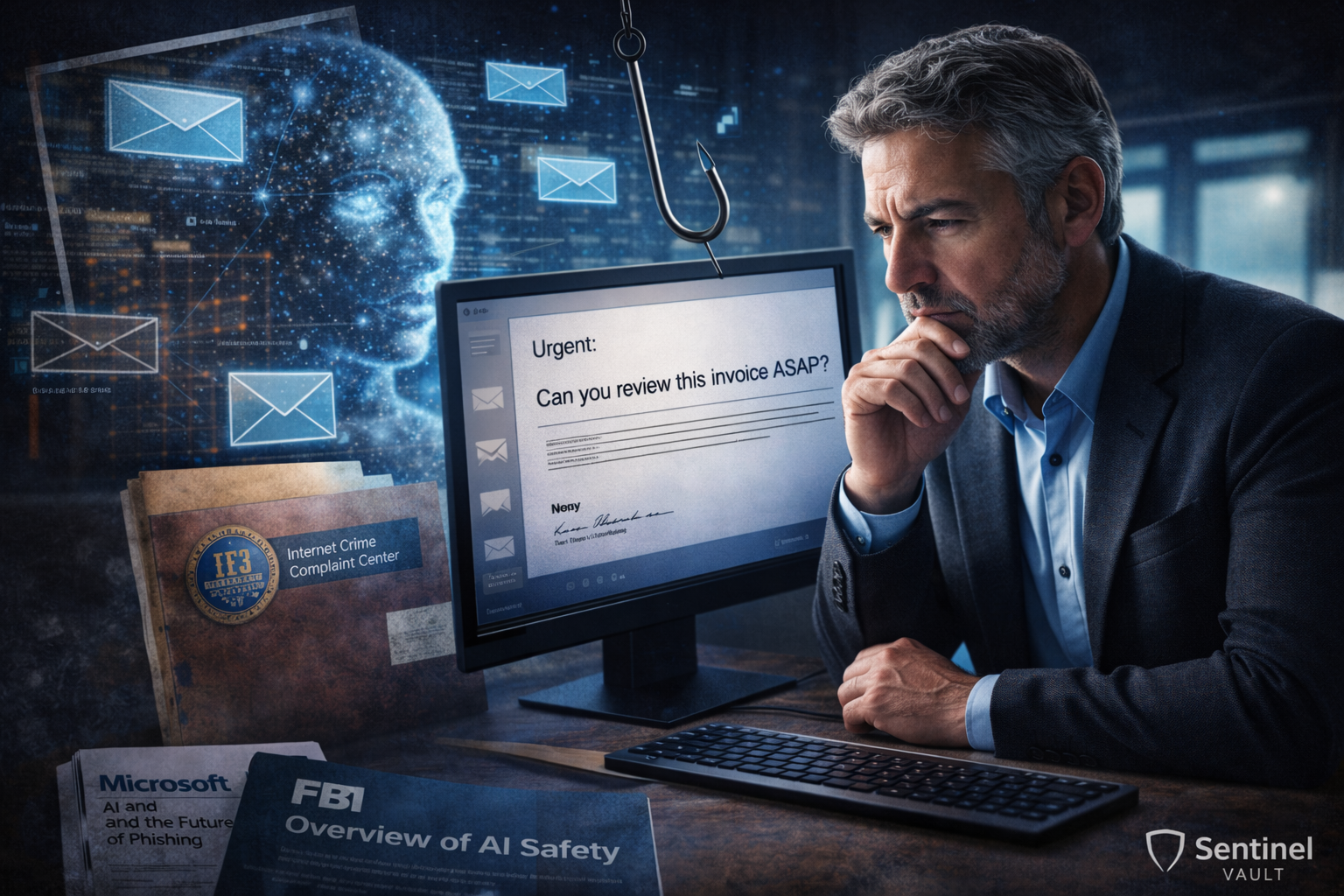
For years, small and mid-sized business owners took comfort in a quiet belief:
“That kind of attack wouldn’t target us.”
Artificial intelligence has erased that margin.
Not because it created new crimes, but because it removed friction. The effort once required to convincingly impersonate a person, a brand, or an internal voice has collapsed. What used to signal sophistication now signals availability.
The most dangerous part?
Many leaders still think they would recognize it.
The New Phishing Problem Isn’t Spelling. It’s Familiarity.
Modern phishing no longer looks like a stranger knocking on the door. It sounds like someone already inside the building.
AI-generated phishing emails are now being trained on:
- Public website copy
- Marketing language
- Press releases
- Social media posts
- Prior breached emails reused across campaigns
The result is not a generic scam. It’s a message written in your company’s voice.
Same tone.
Same phrasing.
Same cadence your staff sees every day.
These messages don’t rush the reader. They don’t threaten. They don’t over-promise. They normalize the request.
“Quick check.”
“Can you take a look?”
“Following up from earlier.”
When employees fall for these emails, it’s not because they were careless. It’s because the message didn’t feel like a risk decision. It felt like routine work.
Microsoft has publicly acknowledged this shift, noting that AI has dramatically improved the quality and believability of phishing content, particularly when attackers tailor language to specific organizations and roles:
https://www.microsoft.com/en-us/security/blog/2023/04/26/the-new-era-of-ai-powered-phishing/
Leadership Failure Isn’t About Tools. It’s About Assumptions.
Most SMBs affected by AI-assisted phishing had:
- Email filtering
- Security awareness training
- Multi-factor authentication
- An IT provider or internal admin
What they didn’t have was a leadership model that recognized behavioral risk as a business risk.
Executives assumed:
- “Our people would spot it.”
- “We’d get a warning first.”
- “AI attacks are still cutting-edge.”
Those assumptions are now liabilities.
According to reporting from the FBI’s Internet Crime Complaint Center (IC3), business email compromise remains one of the costliest cybercrime categories, with tactics evolving faster than traditional controls. The FBI has warned that generative AI is accelerating impersonation-based fraud, not replacing it:
https://www.ic3.gov/Media/PDF/AnnualReport/2024_IC3Report.pdf
The uncomfortable truth is that AI doesn’t need to break systems. It just needs to align with how people already work.
Why Executives Don’t See These Attacks Coming
AI-powered phishing succeeds because it targets blind spots created at the leadership level:
- Overconfidence in Awareness Training
Training teaches people what scams looked like. AI teaches attackers what your company sounds like today. - Delegated Risk Ownership
Cyber risk is often treated as an IT issue, not a decision-making issue. But these attacks exploit authority, trust, and workflow, not infrastructure. - Delayed Recognition
Many organizations only realize something is wrong after money moves, credentials are used, or data leaves. By then, the attack phase is over.
OpenAI has acknowledged that generative models can be misused for social engineering at scale, particularly when paired with public data. This is not a theoretical concern. It’s an acknowledged risk of the technology:
https://openai.com/research/overview-of-ai-safety
The Shift Leaders Need to Make Now
This is not a call to buy more tools.
It’s a call to rethink assumptions.
SMB leaders need to stop asking:
“How do we block AI attacks?”
And start asking:
“Where does trust automatically trigger action in our business?”
Because that’s where AI lives now.
Approval chains.
Routine requests.
Familiar language.
Authority signals.
Until leadership acknowledges that human trust is the attack surface, no technical control will close the gap.
A Quiet Warning for SMB Owners
AI didn’t make cybercrime smarter.
It made it quieter.
And quiet failures don’t announce themselves until the damage is already normalized as “a mistake” or “an anomaly.”
The organizations that adapt won’t be the ones with the most technology. They’ll be the ones whose leaders understand that cyber risk is no longer about systems being attacked.
It’s about decisions being nudged.
If you assume you’d see it coming, that assumption deserves a second look.